


Re-organization and massive budget cuts, including 64% cut to trail maintenance, could break the U.S. Forest Service


New plans to move the headquarters of the U.S. Forest Service, eliminate regional offices and massively cut trail maintenance funding increase risks to the public lands we love and rely on.
By Michael DeCramer
We are at a critical moment. The government agencies tasked with caring for our public lands are losing the funding and staff needed to manage and sustain those beautiful landscapes, with dire implications for future generations. New plans to move the headquarters of the U.S. Forest Service and eliminate regional offices will only increase the risks to public lands that we all rely on.
The Secretary of Agriculture recently announced that the administration is moving the U.S. Forest Service’s headquarters out of Washington D.C., as well as eliminating regional offices — including the Pacific Northwest regional office in Portland, OR.
WTA is concerned that this change will lead to the loss of thousands of skilled public servants. These workers have critical knowledge that helps the government care for our shared national public lands. The Forest Service workers in Washington, D.C., and at regional offices like those in Portland play vital roles in creating partnerships that can reach across multiple national forests. Those employees help support nonprofits like WTA who work on national forests. Without those workers, organizations like WTA can’t effectively work on national forest trails and the Forest Service can’t effectively do its job to care for the public lands for which it is responsible.
This change comes at a time when the Forest Service is already facing major challenges. In 2025, the agency lost 5,800 workers nationally. Some national forests in Washington have lost about a quarter of their non-firefighting workforce over the last 14 months. According to the Forest Service’s own analysis, understaffing is “leading to unpassable trails, unsafe bridges and negative environmental impacts.”
 Some of the most beloved trails in Washington, including those near Mount Baker, are on Forest Service land and are managed by the hard-working Forest Service staff. Photo near Artist Point in the Mt. Baker Snoqualmie National Forest by Todd Entrikin.
We don’t have to look far for a recent example of how restructuring a federal public lands agency can harm workers and negatively impact an agency’s mission. In 2020, the Bureau of Land Management underwent a similar reorganization and moved its headquarters out of Washington D.C. to Grand Junction, Colorado. Approximately 87% of the workers whose positions moved to Colorado left the agency instead of moving across the country. WTA fears that the Forest Service will experience a similar outcome.
Forest Service employees care for our shared national public lands. Thousands of dedicated federal workers, their spouses and their families should not be asked to uproot their lives and move, in this case to Salt Lake City, with as little as 6 months of notice. Many employees will be forced to quit, and with the loss of those employees, the Forest Service will be further hampered in its ability to do its job.
The U.S. Forest Service is a complex organization. WTA does not oppose the idea of adjusting the agency’s structure or streamlining processes, but changes need to be thoughtful and carefully executed. The proposed reorganization will have adverse impacts on the agency’s operations. Moving the headquarters across the country and eliminating regional offices is part of a pattern of undermining the U.S. Forest Service and eliminating the positions of public servants needed to manage our national forests.
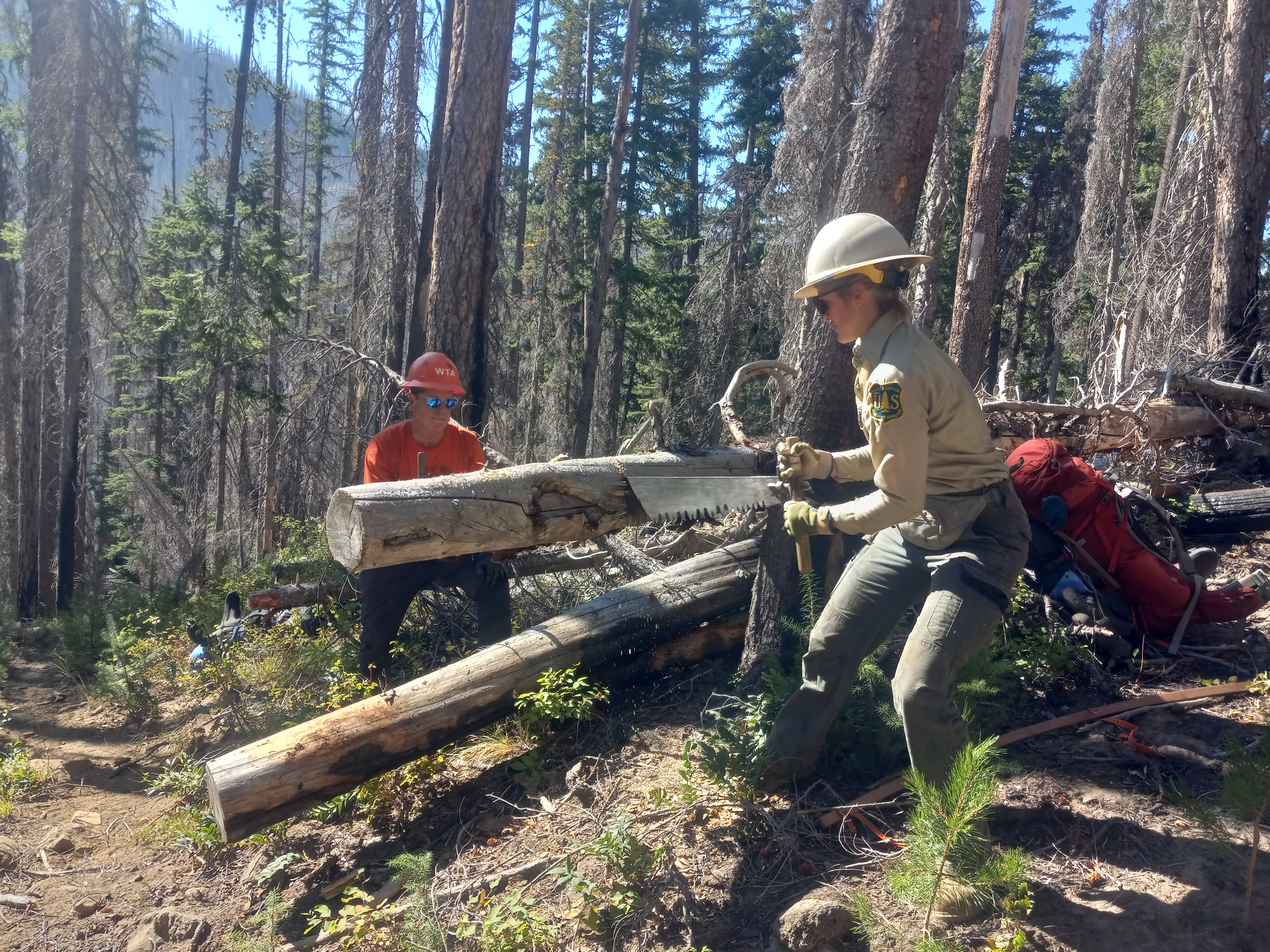 Washington Trails Association and the Forest Service have long been partners in caring for trails. Losing experienced staff with expertise, knowledge and skills will result in less work accomplished across national forests. Photo by Melissa Davis in the Gifford Pinchot National Forest.
The administration’s proposals show that their goal is to shrink the U.S. Forest Service, eliminate programs and cut services. This week the White House released a budget proposal that would cut 64% of funding for trail maintenance on national forests. That’s a $14 million reduction. The White House said they would make those massive cuts while “focus[ing] the Forest Service on the highest priority partnerships with state, county and not-for-profit organizations that currently contribute to workforce capacity for the maintenance and reconstruction of the Forest Service trails system.”
The administration is suggesting that state and local partners can accomplish projects in place of federal workers. That is not realistic. Washington Trails Association is an example of a highly effective Forest Service partner helping the agency accomplish its mission. But we cannot do our work without federal staff, nor can we adequately respond to the challenges facing trails when the White House seeks to eliminate the majority of federal trail maintenance funding. We know what happens when the administration cuts funding and staff and impedes trail maintenance. The U.S. Forest Service’s own analysis found that “Public access, visitor satisfaction, and recreation-based economic contributions will continue to decline in 2026 and beyond without direction to prioritize investments in recreation generally and the trails program specifically… Without this support, the agency risks losing decades of investments in trail infrastructure.”
We know that losing workers with expertise, knowledge and skills will result in less work accomplished across national forests. Some of the work that these Forest Service employees accomplish is highly visible to the public — including work to address the wildland fire crisis and support for projects that reduce the risk of wildfire to rural communities. Other staff in national and regional offices help the Forest Service implement the Legacy Restoration Fund, which is responsible for more than 1,000 maintenance projects in the last 5 years on infrastructure including trails, bridges and roads. Staff impacted by this reorganization also do work behind the scenes. They manage budgets, conduct scientific research, create long-term resource management plans and much more.
The decision to restructure the U.S. Forest Service did not come out of nowhere. The Trump administration has repeatedly attempted to reduce the number of federal workers managing national forests. The White House continues to attempt to dramatically cut the funding available to the U.S. Forest Service.
The changes and budget cuts proposed by the White House have the potential to break the U.S. Forest Service.

Echo Ridge, in the Okanogan-Wenatchee National Forest. Proposed changes to the U.S. Forest Service would make it much harder for the agency to do research work on important topics, including wildfire management. Photo by Jason Gerend.
Forest Service leadership knows that the agency cannot accomplish its mission with fewer staff and less resources. Rep. Kim Schrier (WA) and Rep. Andrea Salinas (OR) recently led 21 of their fellow members of Congress in writing to the chief of the Forest Service to draw attention to the ways in which “trail maintenance operations have been hamstrung by layoffs, hiring restrictions, budget cuts and other policies that make it harder for staff to do their jobs and meet agency objectives.”
Sen. Patty Murray and Sen. Maria Cantwell sent a similar message in February. In spite of that pressure, the administration continues to advocate for cuts that will limit our access to the outdoors.
Our national forests need people to steward them. Contact your members of Congress now.
The administration needs to keep hearing from the American people that spending time outside is essential and that our national forests need to be protected and well managed. The Forest Service needs to retain its workforce so that it can manage our shared lands and care for the trails we all depend on.
 Everyone who counts on Forest Service lands should be concerned about the proposed cuts and reorganization. Photo in the Okanogan-Wenatchee National Forest by Zachary Tolliver.
Breaking down the Forest Service — A timeline
This Forest Service reorganization is part of a pattern that aims to break the U.S. Forest Service by eliminating its workforce. Here are key examples of how the administration has undermined the ability of the agency to manage public lands effectively:
February 2025: The Office of Personal Management directs federal agencies to fire probationary workers. Thousands of Forest Service workers, including seasonal trail crew staff who had recently received promotions into permanent positions, received dismal notifications.
Many trail workers who partner with WTA to care for national forest trails received letters stating, “The Agency finds, based on your performance, that you have not demonstrated that your further employment at the Agency would be in the public interest.” In truth, individuals’ performance was not considered before workers lost their jobs. The firings were ultimately determined to be unlawful, but many Forest Service staff, including experienced trail crew leaders in Washington, chose to leave federal service after being subjected to the stress and uncertainty of being fired and rehired.
March 2025: The Trump Administration directs the U.S. Forest Service to create a plan for mass layoffs, known as a “reduction in force” (RIF). The plans were submitted to the Office of Personnel Management and the Office of Management and Budget.
Russell Vought leads the White House’s Office of Management and Budget. He was also a co-author of Project 2025, an initiative designed to reshape the federal government. In October 2025, Vought said, “We want the bureaucrats to be traumatically affected. When they wake up in the morning, we want them to not want to go to work because they are increasingly viewed as the villains.”
April 2025: Forest Service workers receive an offer to quit their jobs and accept early retirement or a buyout worth several months of pay. Forest Service employees told WTA that they received as many as 20 different emails from government leaders encouraging them to take the offers and leave public service prior to a threatened mass layoff.
As a result, thousands of Forest Service workers left their jobs, leaving many key roles vacant, locally and nationally. In most cases, these positions could not be filled because of administrative policies, including a federal hiring freeze.
June 2025: The Trump Administration asks Congress to cut funding for the U.S. Forest Service in 2026 by about $6 billion (67% lower than 2024 enacted levels). The White House requests to cut trail maintenance funding by $12 million (60% cut).
January 2026: Congress rejects the requested cuts to the U.S. Forest Service. The bipartisan budget increased trail maintenance funding at the Forest Service by $2 million (10% increase).
March 2026: The Forest Service announces what it calls a “sweeping restructuring of the agency,” with a plan to moving agency headquarters to Salt Lake City, Utah, and eliminate regional offices.
April 2026: The White House releases its proposed budget. The budget, for fiscal year 2027, would further reduce the Forest Service’s ability to care for wild places and ensure access to the outdoors. The White House proposal would cut funding for the management of “Recreation, Heritage and Wilderness” by 31%. If enacted, the budget would cut funding for Forest Service trail maintenance by 64%.
The White House budget shows the administration’s intention to continue cutting the number of staff who care for our public lands. It assumes that the Forest Service will lose thousands of additional positions in fiscal year 2027.

The sunrise over Red Top Lookout in the Okanogan-Wenatchee National Forest. The Forest Service cares for many places like this, where you can find awe and the many benefits of time spent in nature. Photo by Lee Wang.
Comments