


New trail to top of Big Rock took jackhammers, rock drills and many volunteers


The WTA crews have dared to do what the glaciers could not: Make a trail up Big Rock. The new route offers safe access to stunning views of the Skagit Valley.
By Kesia Lee
The important thing to know about a typical day on Big Rock, is that there is no such thing as a typical day on Big Rock.
The daily crew of volunteers is a mix of recent college grads, retired veterinarians, Boeing engineers, empty nesters and local trail enthusiasts. Together, they might be hauling buckets of gravel for 7 hours, battling scotchbroom with a view of Mount Baker in the distance, trying to sculpt stairs with rock drills, or hauling 16-foot wooden beams up the side of a cliff.
The one constant is that above it all — above the jokes and complaints and shouted math — is the constant dull ringing of a jackhammer chiseling away at the glacially polished stone.
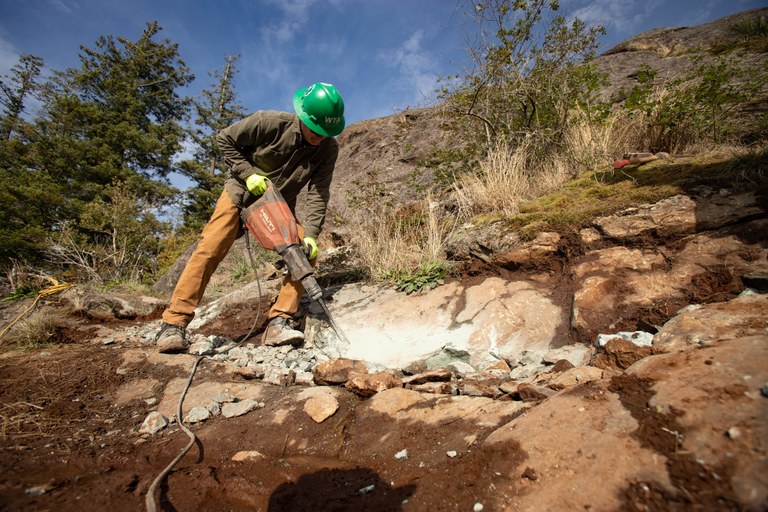
A WTA volunteer uses a jackhammer to help create a new trail on Big Rock in Skagit County. Photo by Kesia Lee.
A view that has drawn people from time immemorial
The project at Big Rock (and wow is it a big rock) is a testament to the power of WTA’s volunteer crews. While there have long been paths up the rock, it’s always been a treacherous scramble. Nevertheless, people have been climbing it since time immemorial. The top of the rock features in a story by the Upper Skagit Tribe about Star Child coming down from the skies. And the view has drawn locals for decades. After a climb of about 200 to 300 feet, hikers are greeted with a 360-degree view of the Skagit Valley as well as Mount Baker and the Cascades peaking through on a clear day.
The valley floor lays far below, and flocks of migrating birds fly in formation around the rock. It’s an awe inspiring place. Many life-time Skagit residents have been climbing it since they were kids. But there has not been open public access to the top of the rock in many, many years. WTA partnered with Skagit County, Skagit Land Trust, and the Upper Skagit Tribe to create a trail that would restore safe cultural and public access to Big Rock. Everyone was confident a trail could be built. The question became: just how many stairs would it take?
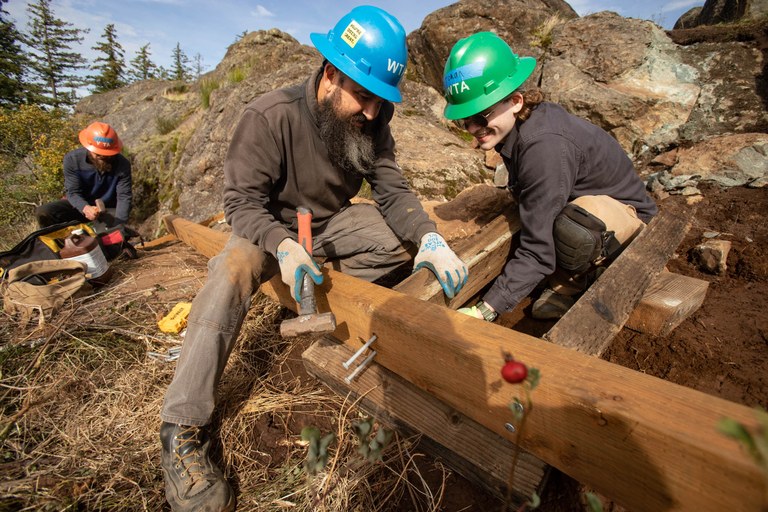
A WTA crew assembles one of many structures used to build a trail at Big Rock. Photo by Kesia Lee.
Glacial stone makes for tricky trail-building
That question was answered by dedicated volunteers and many months of loving labor. And a LOT of stairs. Every morning the crew hauled out a generator in a net, a jack hammer carried over the shoulder, bags full of rock drills and saws schlepped by hand, and a dozen digging tools in a giant mechanized wheelbarrow called a toter. To protect themselves against the constant noise of the toter, generator, jack hammer and two rock drills, the crew members wore earplugs and communicated with shouts and elaborate pantomime.
The glacially polished green stone took days to manipulate into a buildable surface and came away only as small flying shards from the jack hammer or dust from the rock drills. With the required hardhats, safety glasses, gloves and bundled layers to protect them against debris and sideways rain, the crew looked as though they were about to go on a journey deep into a forbidding mine.
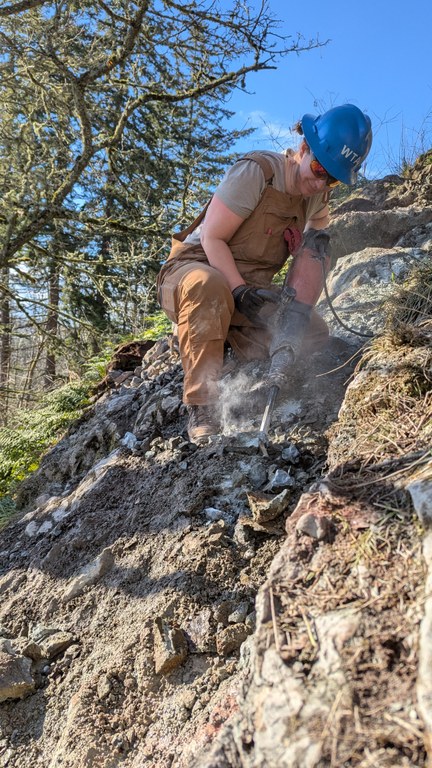
WTA crew leader Kesia Lee uses a jackjammer on the Big Rock trail. Photo courtesy Kesia Lee.
14 months & 48 days of volunteer determination
And yet, despite the many challenges, the mood was usually that of jubilant determination. When they started at Big Rock, the majority of the volunteers had never sculpted rock with a jack hammer or built a 16 foot crib-ladder. Most had never wrestled a toter full of gravel over uneven terrain. And yet, they managed to build twelve sets of stairs with over 100 steps all with zero injuries over the course of the project.
The WTA crews have dared to do what the glaciers could not: Make a trail up Big Rock. Over 48 days and 14 months, the crew etched a quarter mile of trail and stairs leading from the base to the top of Big Rock. Their efforts will last for decades to come and add another layer to the unique cultural and geological history of Big Rock. Together, the crews braved freezing conditions, long days, aching limbs and satisfying challenges to bring a new trail system and green space to Skagit County.
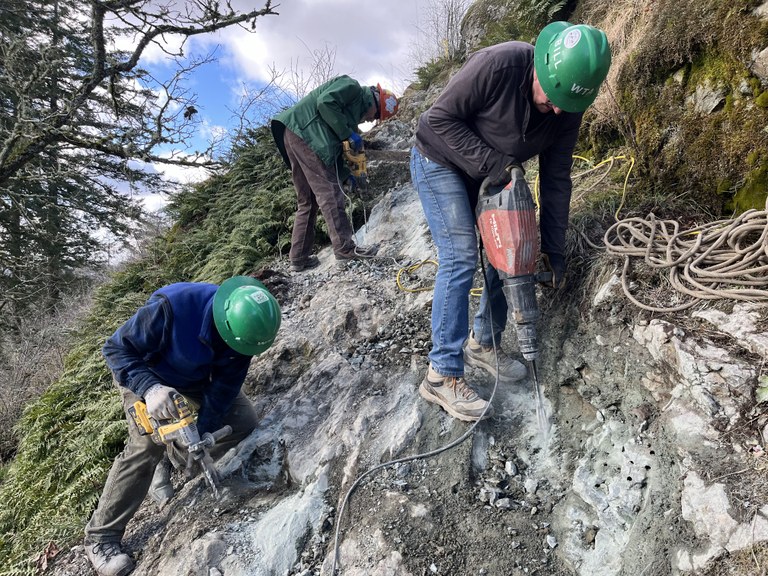
It took many volunteers and a lot of tools to shape the new trail up Big Rock. Photo by Kesia Lee.
Big Rock is now open to the public, with a temporary parking lot and a short walk up a gravel roadbed. We recommend that you take an afternoon to check out the view and the showcase work done by WTA over the course of 2025 and beyond. And the next time you climb up a series of stairs on a mountain in the middle of nowhere, take a moment and appreciate the ingenuity and dedication of all the trails crews of times gone by.
WTA is planning to do more work at Big Rock in the fall. In the meantime, we have other work parties available across the state and we'd love to see you. No experience necessary.
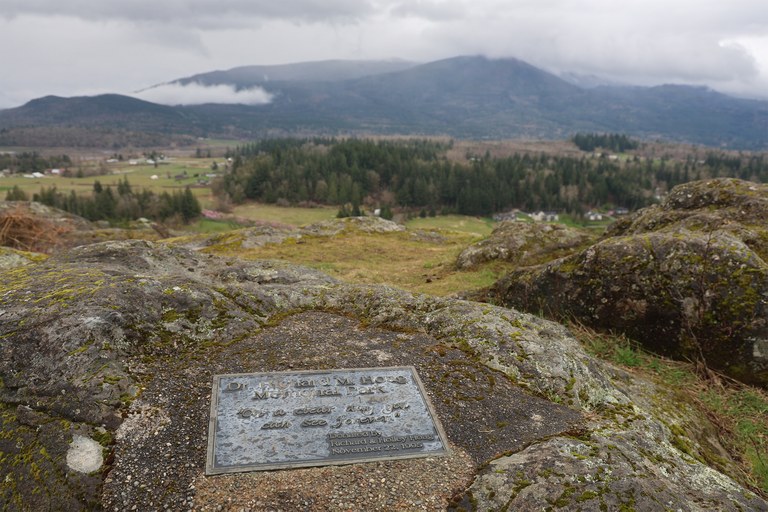
Big Rock offers wide views and, on a clear day, you can see all the way to Mount Baker. Photo by Victoria Obermeyer.
Comments
Well done. Scrambling up this in 1998 was fun. When first hearing of this, I thought the rock itself should remain a scramble, but it was also fun hiking up it.
https://www.peakbagger.com/climber/ascent.aspx?aid=3267768
Posted by:
Fred Beavon on Jul 19, 2026 01:05 PM