


Making art for a rapidly changing world


Suze Woolf creates art that invites the viewer to take a deeper look at climate change.
Suze Woolf, an artist and WTA Fireside Circle member, has been hiking for most of her life — and she’s seen a lot change on trail over that time.
In the early 2000s, she began noticing more burned areas. Around then, she also traveled across Canada and saw many areas of beetle kill.
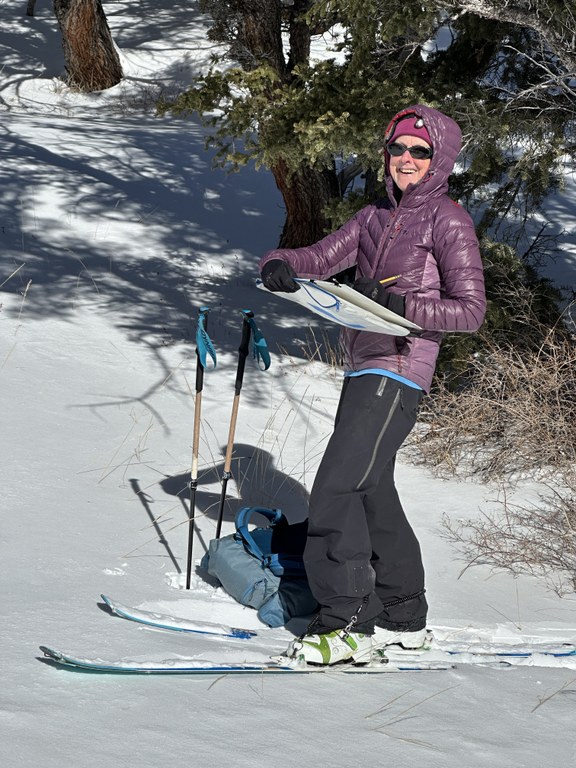
Artist Suze Woolf
“There is a surprisingly complicated relationship between beetle kill and fire,” she said. “Both are symptoms of climate change. In my artwork, it’s the same subject matter, they just look completely different.”
A lot of Suze’s art focuses on climate change. Long before she noticed burned areas and beetle kills, she had seen glacial retreat.
“I was worried about it, and at the same time I found it fascinating,” she said.
She’s taken that fascination — with change, glaciers, wildfire and more — and used it as a source of inspiration. Her art is varied and creative, but it all invites the viewer to look closer, to think and to question.
Suze’s anxiety about climate change and her fascination with burnt landscapes led her to create her “Burnscapes” series. These paintings, most of which are created on torn paper mounted on shaped board to increase their presence, show the intricate details of burned trees. Many are ones that Suze encountered hiking in Washington.
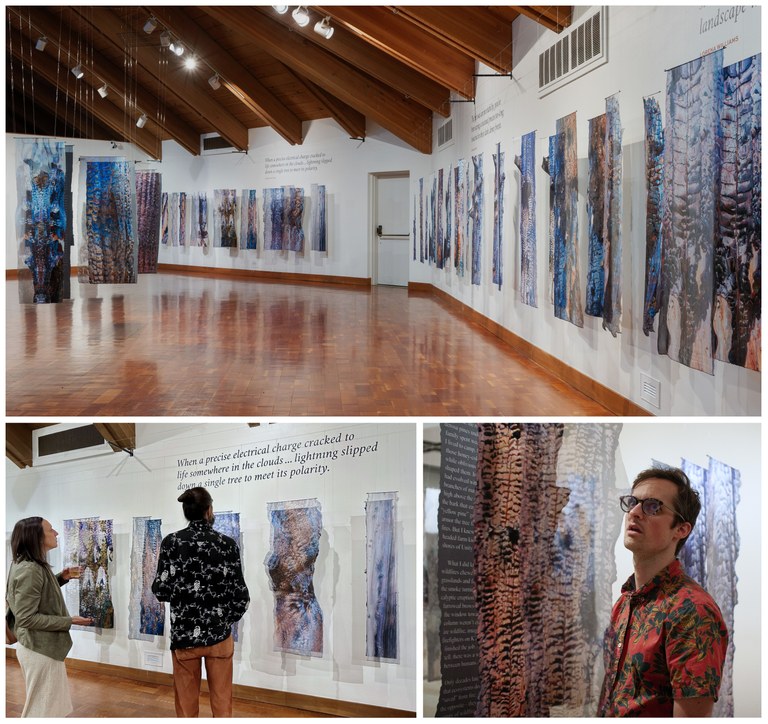
Suze Woolf’s “State of the Forest” while it was on exhibit at the World Forestry Center in Portland, Oregon.
That art eventually became “State of the Forest,” a traveling installation of 30 of her tree paintings digitally transferred onto fabric — a transparent layer, a solid layer and plain or story black layer — suspended from the ceiling.
“The whole experience of seeing burned areas with greater attention made me realize that forests are transitory. They always were, but we don’t always see it in our lives,” she said. “But because I was seeing them change so much, they started to feel temporary. I wanted the feeling of the fabric moving and feeling ephemeral.”
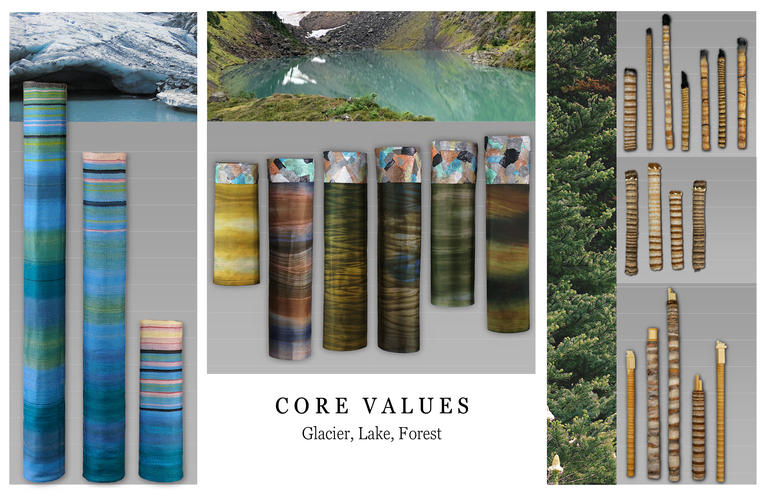
Core values, created by Suze and fellow artists, used fiber arts to illustrate the past and the present.
As part of the “Terminus” project at Olympic National Park, Suze worked with fellow artists Arisa Brown and Janet Stone to create three sets of cores — a method of understanding used by field scientists in many fields. But coring only shows the past. Artists can envision the future. The Bretherton Snowfield in Olympic National Park used to have a glacier, but it is now an ice remnant. For “Core Values,” the artists created textile cores to illustrate both the past and a possible future. Suze knit and felted wool to make tree cores; Arisa created sediment cores by dyeing and quilting fabric and Janet used weaving to build ice cores. The works were also shown at Klondike National Historic Park in Seattle.
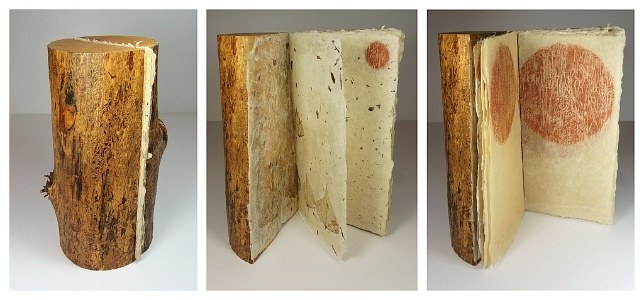
Suze's "books" show a new look at the damage from bark beetles.
For another body of work, Suze has created what she called Bark Beetle Books. They look somewhat like books — but instead of a cover and pages, there’s the bark and wood of trees that have been affected by various beetle species. Suze was inspired to create these works after noticing these hieroglyphic patterns — officially called galleries — on scraps of bark on the trail.Suze hopes that her work sparks something in viewers that encourages them to think more and explore deeper.
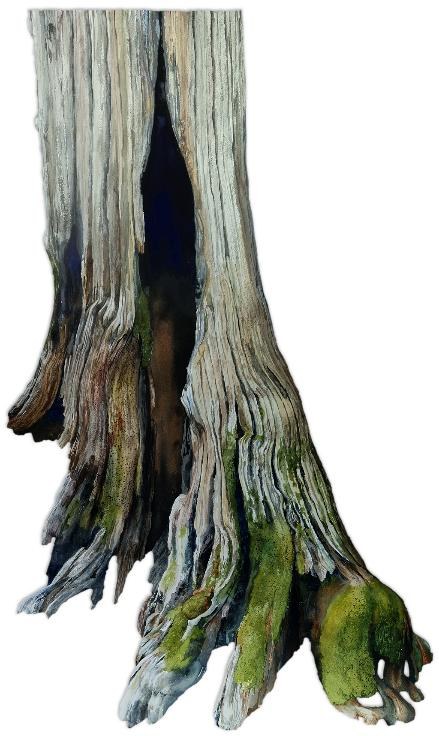
One of Suze's paintings from her Burnscapes series.
“I don’t expect to be able to solve climate change with my work,” she said. “But I can start a lot of conversations and that’s my goal. … If someone looks at something I did and wonders ‘Why did the artist do that?’ then I’ve won. It’s upsetting for some people, because of course fire can be traumatic. But it will also get that person to stop and think.”
See more of Suze Woolf’s artwork at suzewoolf-fineart.com. Parts of “Core Values” are on display in Auburn through Oct. 10. Get details on that, and where else you can see her art in person, at suzeart.wordpress.com.
Comments