


Protect our national forests with thoughtful designation of roads, trails and areas for motorized vehicles


For decades, the U.S. Forest Service has worked to protect soil, water, wildlife and vegetation — and promote the safety of all visitors, including hikers — by designating certain areas in national forests as open to off-road vehicles and keeping other areas closed to motorized travel. Right now, the administration is proposing to throw out that system. Take 30 seconds to speak up for national forest trails.
By Michael DeCramer, WTA policy and planning senior manager
The U.S. Forest Service has worked for decades to protect soil, water, wildlife and vegetation — and promote the safety of all visitors, including hikers — by designating certain areas in national forests as open to off-road vehicles and keeping other areas closed to motorized travel. In response to an executive order signed by President Trump, the Forest Service is attempting to throw out the existing framework for designating which trails, roads, and other routes are open to motorized recreational experiences and which areas are closed to those uses.
This policy change, if implemented, would significantly impact the experience of hikers, horseback riders and other nonmotorized visitors on our national forests.
Most hikers prefer to hike on quieter, non-motorized trails. In many trail environments, it can be difficult for a hiker to safely move off trail if surprised by a fast-moving motorized vehicle.
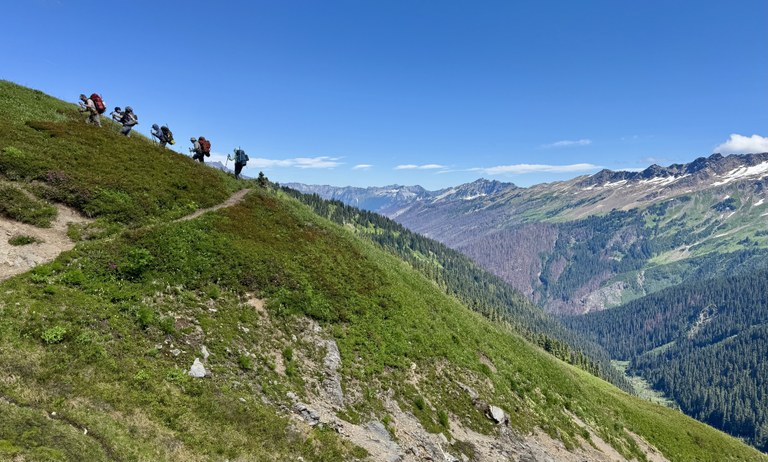
Speak up now to preserve the Travel Management Rule, which helps protect hikers, trails and the environment. Photo by Jennifer Mickle.
The current regulation, known as the Forest Service’s 2005 Travel Management Rule, protects the environment while better allowing non-motorized users to find solitude and quiet recreation. It also provides certainty for motorized users, hunters, anglers, mountain bikers, hikers, and other visitors about where motorized use is legal, sustainable and dependable. This clarity gives all visitors the ability to find the experience they desire.
The administration proposes to flip the existing regulatory framework upside down. Instead of designating certain trails and areas as open to motorized travel, under a new system the Forest Service would start from a presumption that trails and other areas on Forest Service land are open to motorized use, unless they are explicitly closed. This is an unnecessary change to how national forests have been managed for decades.
The proposed change will take large amounts of resources from other land management priorities. The new policy would create an annual review process with the potential to continually open more trails to motorized vehicles. Reviewing the trail system each year would create unnecessary work for Forest Service staff and require the public to engage repeatedly to advocate for key nonmotorized trails and sensitive areas.
Requiring Forest Service staff to continually consider ways to expand motorized access would make it harder for the agency to maintain its more than 368,000 miles of existing roads and 64,000 miles of motorized trails. Critical access routes to trailheads will suffer. What's more, the administration's efforts to dismantle the existing system of rules and promote motorized access at the expense of other visitors will create confusion and unnecessary conflict between users.
Take Action
The Forest Service has taken the first step in throwing out the existing rules for managing motorized travel by issuing a notice of intent to change the Travel Management Rule. Right now is a critical moment to stand up for national forests and speak out for the places that we love to hike.
Use the button below to tell the Forest Service to abandon its proposed changes and keep the existing Travel Management Rule.
Comments are open through Sept. 23
Want to do more?
Changing the Travel Management Rule is one of many ongoing threats to our public lands. Right now, another major protection for national forests is in danger of being removed. If you haven’t yet, take 60 seconds to speak up for the Roadless Area Conversation Rule, which protects more than one-quarter of our national forests.
Comments