 Washington Trails
Association
Washington Trails
Association
Trails for everyone, forever
Washington Trails
AssociationTrails for everyone, forever
Seattle Mountain Rescue volunteers have been helping hikers and other people who love the outdoors for decades. | By Tiffany Chou
WTA works every day to get people out on trail. We build and maintain trails, advocate for making them more accessible and create resources to help hikers to stay safe. But WTA can’t do it all — it takes a wide range of groups to care for the outdoors and the people who love being outside. And sometimes, things do go wrong. When they do, it’s nice to know that search and rescue organizations are there to help.
Seattle Mountain Rescue (SMR) is one of those groups that can help hikers or other outdoor recreationists when something goes wrong. Their motto: “Everybody comes home from the backcountry.”
SMR has been training volunteers for rescue and recovery missions in the mountains since it was founded in 1948. The organization is a nonprofit based entirely on volunteers and supported by donors. There’s no cost for calling for help. While SMR takes on missions of all kinds, its volunteers have special training for missions that require expertise in wilderness travel, climbing, snow travel and remote medicine.
SMR has seen a significant increase in missions over the years. It had an average of five missions per year in its first 10 years. In 2023 alone, between May and September — peak mountain recreation months — it took on about 100 missions. As more and more people access our natural areas, some of them are going to need help. And SMR is ready.
SMR’s volunteers come from all backgrounds. Many are health care workers, like doctors and EMTs, but they all share a passion for the outdoors and care for their fellow outdoor enthusiasts. And SMR has actively worked to develop an inclusive culture, focusing on its recruiting process (for instance, utilizing AI to revise the process to remove gender bias), creating a positive teaching and learning space, and building a mentorship program.
SMR missions take many different forms, including searching for lost hikers (in both urban and remote areas), providing medical care for those who get injured in the backcountry and evacuating outdoor enthusiasts when necessary.
Some missions, especially those in easy-to-reach areas, take a few hours and need just a few responders. But difficult missions farther out in the backcountry can last for days and require dozens of responders. One mission in 2020 lasted over a week and 43 SMR volunteers responded.
SMR is always working to increase efficiency and safety. One way it has done that recently is by focusing on technology.
Volunteers used to have to make individual phone calls to ask for help with missions. Now, SMR uses text messages to reach many volunteers at once, tracks them on a digital map and uses radio and satellite phones to keep in contact with them in the field.
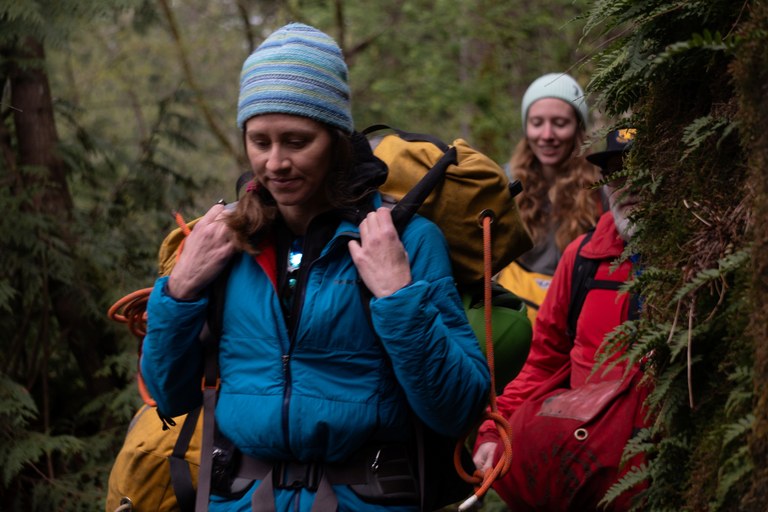
Volunteers always carry specific gear on their missions, including ropes and radios. Photo by Jenna Phillips, Seattle Mountain Rescue.
In 2021, with funding from the Snoqualmie Tribe, SMR added a thermal imaging drone to their toolbox and trained volunteers to use it. The drone has been particularly useful in winter or with difficult terrain like rivers or cliffs. SMR has also used the drone to help other organizations, including for monitoring active fires. And SMR has provided drone imaging data to the University of Washington for research into rescue automation tools, which could help search and rescue find people faster.
SMR also developed a new, lighter rope system, which worked so well that it helped roll the system out to other King County search and rescue teams.
While SMR works hard to be ready to help those who need it, it also hopes its services are needed as infrequently as possible. For years, SMR has hosted events to educate the hiking community on how to stay safe in the mountains. Earlier this year, it led “how to stay safe in the outdoors” education events for the Girl Scouts and Team Survivor NW, and it has previously hosted multiple wilderness first aid and avalanche safety courses.
Garth Bruce, SMR’s technology chair and leader of its drone search team, hopes the Mountain Rescue Center will be a good spot to lead education events for the greater outdoor community — after all, the best treatment is prevention.
“What SMR wants is less business. And that means educating people, oftentimes showing them why mistakes were made and how they could have been avoided,” Garth said.
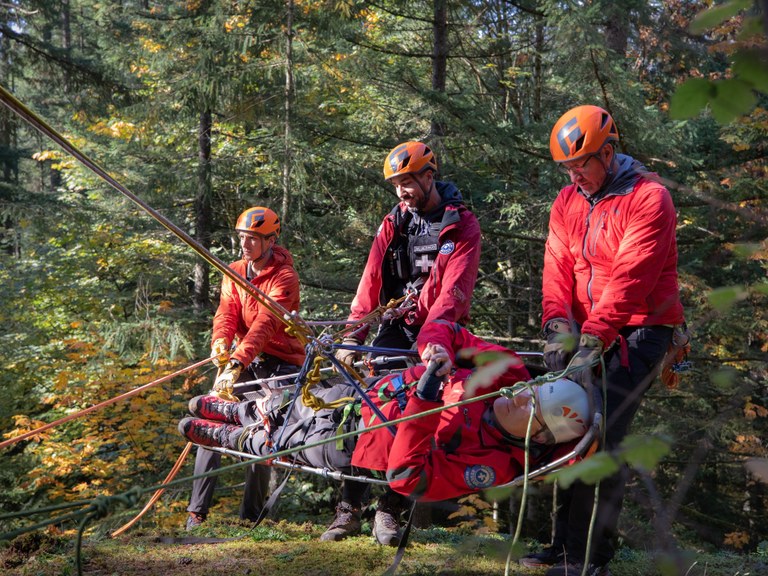
Training involves mock missions, which imitate rescue missions SMR members might embark on in real life. Photo courtesy of Seattle Mountain Rescue.
Half of the Mountain Rescue Center’s space was specifically designed to be a classroom, designated for partner organizations’ wilderness medicine courses, avalanche and snow safety classes, seminars and the like. Education is an important element in keeping the public safe, but having fewer missions overall keeps SMR’s volunteers safer too.
SMR prioritizes regular, practical training and has earned grants to help outfit volunteers with gear — first aid kits, radios, rigging kits — to keep them safe and support their ability to respond faster to calls. It even has a resiliency team to ensure volunteers are OK mentally and physically after a potentially traumatizing mission.
As long as there are people in the backcountry who need help, SMR’s volunteers will be at the ready. Like many of its volunteers, Garth puts much of his time and energy into SMR — and he’s not planning to stop anytime soon.
“Being able to support and help people if they needed it was the perfect path for me, given my nature and passion for the mountains,” Garth said. “I have given a lot to SMR over the years, but it has paid me back tenfold. I’ll always support it and help people when needed.”
Interested in joining SMR? Check out its website at seattlemountainrescue.org
or email info@seattlemountainrescue.org to ask about current volunteer opportunities, both on the ground and behind the scenes. There are dozens of other search and rescue organizations across the state too — look up the ones in your area online to find out how to join!


