Washington Trails
Association
Washington Trails
Association
Trails for everyone, forever
Washington Trails
AssociationTrails for everyone, forever
For a modest weight, the right backpacking pillow can help you sleep better and wake ready to cover more miles. By Sandra Saathof
After an adventurous day of powering up and down switchbacks and across mountain ridges, there’s nothing like crawling into your tent and drifting off into a night of blissful slumber. But if you’ve ever spent a night in the backcountry with your head sliding off your pillow, or woken up with a crick in your neck, you probably haven’t found your best backpacking pillow yet.
The case for using a pillow comes down to sleep quality. When you’re covering miles, day after day, proper rest isn’t just about comfort. A good night’s sleep helps your muscles repair and get ready for the next day’s efforts. It keeps your mind sharp, able to make quick decisions about foot placement and navigation. And it just makes the whole backpacking experience more enjoyable if you’re not falling asleep on your feet.
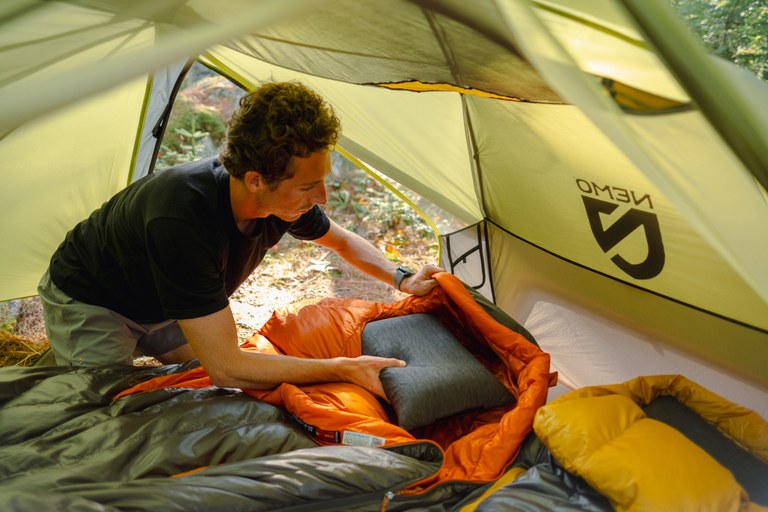
For a modest weight, the right backpacking pillow can help you sleep better and wake ready to cover more miles.
Regardless of whether you’re sleeping in your bed at home or in a tent in the backcountry, proper neck and spine alignment is crucial. The goal is to keep the spine in a natural alignment, both front to back and side to side.
For people who sleep on their backs, the pillow should support the natural curvature of the cervical (neck) spine.
For side sleepers, the pillow should support the head and neck so that the spine maintains its natural horizontal line. Generally, this translates to a slightly thicker pillow for side sleepers than for back sleepers.
Additionally, for side sleepers, a pillow between the knees helps to keep the pelvis and lower back in alignment, which can help to prevent back pain.
If you prefer to sleep on your stomach — the most difficult position for the back and neck — a relatively flat pillow under the head can help reduce stress at that end, while another one under the stomach can help keep the lower back in better alignment.
Whether you choose to stuff some extra clothing in a stuff sack or purchase a dedicated backpacking pillow, the weight (and space) penalty is quite modest. Most dedicated pillows weigh between 2 and 6 ounces — equivalent to a couple of energy bars at most.
Backpacking pillows can be classified in four main construction categories.
Homemade pillows are often the least expensive option. It is entirely possible — and many of us have done this for years — to use what you have with you to make a pillow each night at camp. The stuff sack your quilt or sleeping bag lives in during the day can be stuffed with the clothing you’re not wearing at night. Sometimes this is enough. If you carry a puffy jacket but don’t need to sleep in it, you’re almost guaranteed some amount of comfort. That said, sometimes a homemade pillow ends up being lumpy, inconsistent and annoying to try to sleep on.
Inflatable pillows use air as their primary support mechanism. Typically, they feature a nylon or polyester shell with a valve for inflation and adjustment. They pack down small and weigh very little but can be noisy to sleep on and leave you feeling like you’re balancing on a balloon.
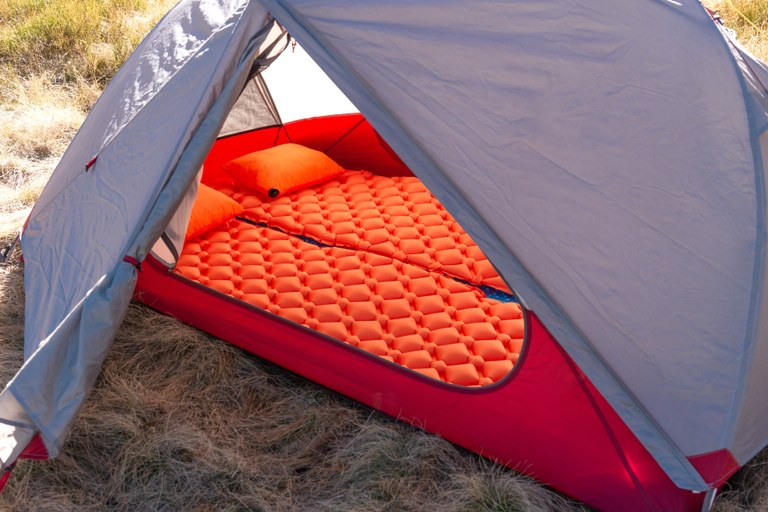
Inflatable pillows weigh little, but might by noisy.
Foam pillows use either open-cell or closed-cell foam as their core material and generally some kind of nylon or polyester outer layer. Open-cell foam is soft and compressible but absorbs water if it gets wet. Closed-cell resists moisture and is firmer but less packable. Both are heavier than inflatables.
Hybrid designs combine air chambers with foam or other insulation. The air provides adjustable loft and the foam adds more cushion, which makes them feel more like an at-home pillow. Some models offer a layer of down for even more comfort. The weight of these tends to be in the middle of the inflatable and foam pillows.
Size and shape significantly impact both comfort and packability. Rectangular pillows offer the most traditional feel and plenty of real estate for restless sleepers. Contoured or ergonomic designs cradle the head and neck more specifically, which some find supportive and others find restrictive. Wraparound styles curve around your neck and are particularly popular with ultralight hikers using minimalist sleeping pads.
Adjustability is a major advantage of inflatable and hybrid pillows. By adding or releasing air, you can fine-tune the loft to match your sleeping position and personal preference. Some hybrid models feature removable foam inserts for further customization.
Surface texture matters more than you might think. A brushed fabric surface feels more like home and can be more comfortable against bare skin, while smooth technical fabrics are lighter and pack smaller but may feel clammy or cause your head to slide around.
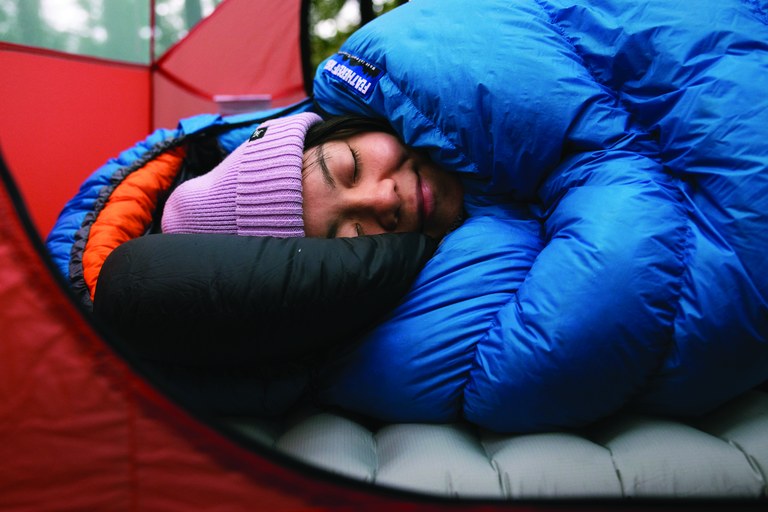
The right pillow can make for a much better night of sleep while backpacking. Photo courtesy Feathered Friends
Attachment systems help keep your pillow in place throughout the night. Some pillows feature sleeves that slide over the top of your sleeping pad, while others use elastic straps or toggles. A pillow that stays put means fewer middle-of-the-night adjustments.
And don't overlook noise level — some inflatable pillows crinkle with every move, which can be annoying for you and your tentmates.
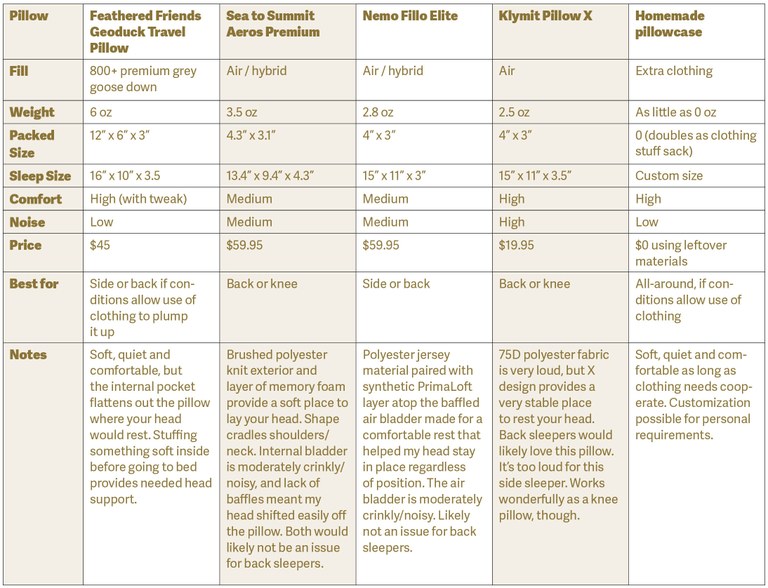
I have been on a quest over the past year to find the best pillow for my own backcountry nights. I’m a side sleeper and also sleep with a pillow between my knees, including while backpacking, so I don’t wake up with an angry lower back. In the past, I’ve stuffed extra clothes into one stuff sack for my head pillow and other items into another stuff sack for my knee pillow. Pack weight does matter to me, so finding a new solution that doesn’t add too much is desirable. This past backpacking season, I had the opportunity to test a few different options.
Feathered Friends Geoduck Travel Pillow
Sea to Summit Aeros Premium
Nemo Fillo Elite
Klymit Pillow X The right pillow can make for a much better night of sleep while backpacking.
A homemade upgrade — a pillowcase I sewed using an old silnylon tent. I installed a zipper on one end so the contents wouldn’t fall out during the night.
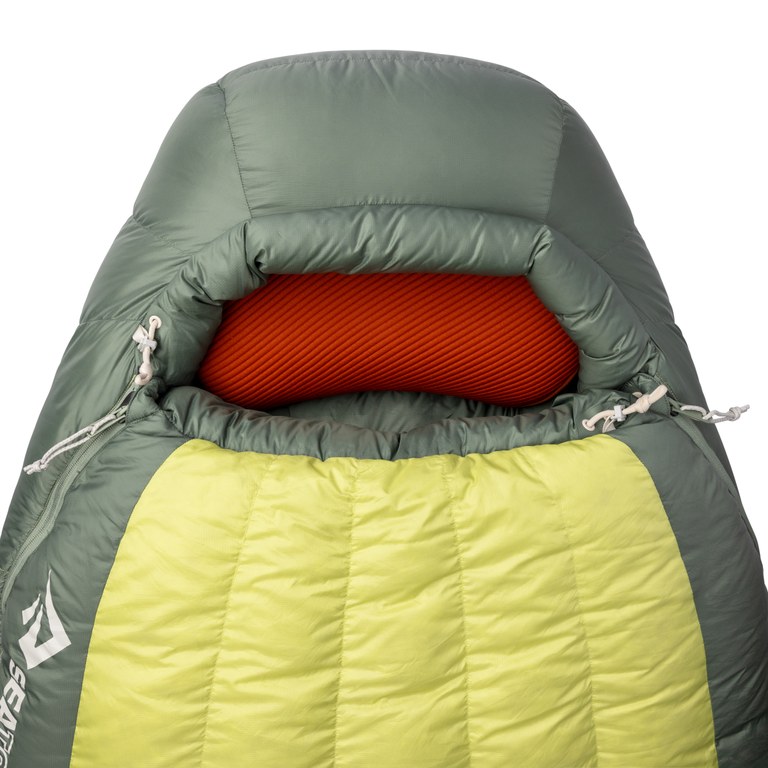
Rest is the best. What kind of pillow will you try? Photo courtesy Sea to Summit.
There were many things to like about each of the pillows I tested. I suspect if I was a back sleeper, my choice would have been much more difficult. In the end, my homemade pillowcase stuffed with daytime clothing and my puffy jacket provided the quietest, most comfortable and customizable pillow for my needs. I got better sleep without the crinkly air bladders waking me up. My second choice was the Feathered Friends Geoduck with a piece of clothing stuffed inside. The packed size and weight would be an issue for me on longer trips, but for a couple nights out, I have no qualms about taking this pillow. As for knee pillows, any of the options would be completely acceptable.
This is a very personal decision. Whether a dedicated backpacking pillow belongs in your pack depends on your priorities. A pillow can significantly improve rest and recovery, and thus the whole backpacking experience. In my opinion, finding a pillow that provides comfort without too much of a weight penalty is worth the improvement in sleep. For short trips or car camping, taking a pillow is a no-brainer. Sleep well, my fellow travelers!