 Washington Trails
Association
Washington Trails
Association
Trails for everyone, forever
Washington Trails
AssociationTrails for everyone, forever
Ian Mackay is using his experience to help others with limited mobility enjoy time on trail. By Jessi Loerch
Ian Mackay lives in Port Angeles, near the Olympic Discovery Trail. It’s a trail he knows well, one that gave him a path back to the outdoors after a major accident. And in recent years, it’s become the setting of one of the most visible parts of his work to improve accessibility for people with limited mobility.
When he was 26, Ian was in a bicycle accident that paralyzed him from the neck down. His life changed in innumerable ways. Once he was able to leave the hospital, Ian moved to Port Angeles, where his family had recently moved. He’d only visited their new home a few times. Now, with limited mobility and dependent on others for help getting around, he was mostly stuck at home. Ian is a nature-loving adventurist with a background in biology, however, and with help and creativity, he began to explore beyond his home.
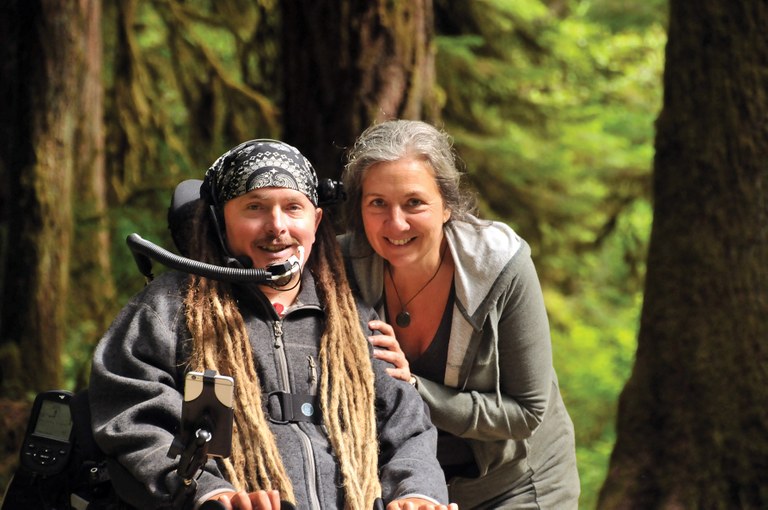
Ian Mackay and Teena Woodward, his mother. Photo courtesy by Fitch
The Olympic Discovery Trail gave him a path to test his limits, find the nature he craved and enjoy freedom and self-sufficiency. He initially traveled the section of trail near his home. Eventually, he started exploring farther.
Ian began meeting people and enjoyed watching wildlife. Once, when he detoured off the trail to a nearby road, a curious weasel jumped up onto his foot. At first, Ian was charmed, but when he tried to move his chair, it wouldn’t respond. Just as he was becoming truly alarmed, the chair moved and the weasel jumped off, vanishing into the brush. It was one of many memorable moments on his outings.
Relatively early in his explorations, Ian’s family took him to the Morse Creek trailhead of the Olympic Discovery Trail. The parking lot was uncomfortably potholed, but he made it to the trail and up to a trestle bridge across the river. He was delighted to actually be able to see the river below him and to smell it.
As he rolled farther, taking in the feelings of nature in a new way, “I felt a glimmer of my old self and the things I loved before I was injured. … I had the sense that things could get better. Not right off, but maybe eventually.”
Those early explorations grew longer, and Ian dreamed up a big goal. He wanted to ride his wheelchair across the whole state, from Canada to Oregon. It was his first long-distance ride, and he charted a route along multi-use paths and quiet roads. Along the way, he got his first chance to share the trail with other wheelchair users — a highlight of the trip for him. His trip caught attention and along the way, he was on TV and spoke to public officials about accessibility. He even met Gov. Jay Inslee, who named him “Washingtonian of the Day.”
That experience of community on trail was powerful for Ian and helped lead to more events, including Ride Tahoma, which Ian and Marsha Cutting, a community organizer who also uses a wheelchair, started in 2017. Together, they and other wheelchair users explored the trails around Paradise in Mount Rainier National Park.
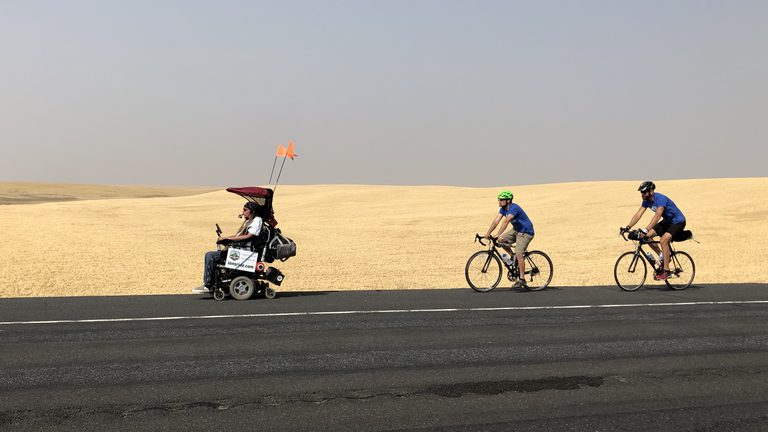
More long-distance rides followed, including a trip from east to west across Washington. Ian and his family and friends were becoming experts at all the logistics of such a long ride in a wheelchair. Ian wanted to be able to share those skills — and the experience of being in community on trail — with other people.
That hope led Ian to create a nonprofit, Ian’s Ride, and Sea to Sound, the nonprofit’s signature event. Sea to Sound welcomes wheelchair users, cyclists and others who want to spend time outside to explore 74 miles of the Olympic Discovery Trail. The first year, there were 12 wheelchair users. In 2025, there were over 40.
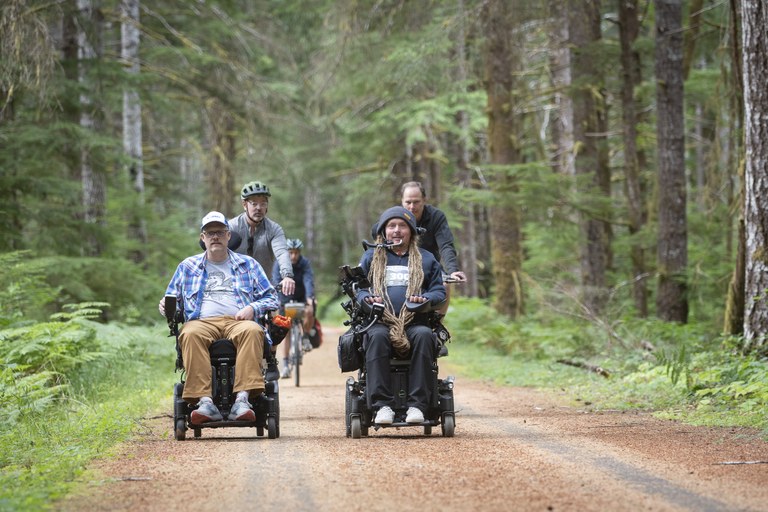
Ian rides on the Olympic Discovery Trail along with Jon Snyder (front left), Gov. Jay Inslee’s outdoor recreation and economic development senior policy advisor, who joined Ian and other participants for 5 miles in a wheelchair during Sea to Sound. Photo by Kyu Oh
“As far as I know, it’s the only event in the country where fully supported individuals can travel that far in a power chair and really push their limits,” Ian said.

Putting on the event is a ton of work. It requires organizing transport, lodging, food, medical support, mechanical support for both wheelchairs and bicycles, and so much more for the participants. Ian is grateful to have support from his fiancée, his mom and others to help make it happen.
“It’s so special to so many people,” he said. “It’s a wonderful time for people to experience the beauty of our neck of the woods. It’s also so important for the community aspect.”
The participants get the benefit of talking with each other and seeing different types of mobility equipment. Cyclists also participate, and it gives different trail users a chance to interact. And the bike riders can help out if someone drops something or if a participant needs a push up a hill.
“It’s important to normalize riding along with people in a wheelchair,” Ian said. “People get to see folks enjoying infrastructure that might mean a lot to them too.”
Ian says that after the event, he needs about a week of sleep to recover, but it’s worth it.
“We hear all these stories from people about how it was a life-changing experience and that they would have never done something like this if we hadn’t provided support,” he said.
Ian’s work has three main goals — to increase outdoor accessibility, to further the availability of accessible technology and to encourage support services for people with mobility impairments.
Ian co-leads weekly online support groups and monthly in-person groups. He also works with technology companies, including Apple, to improve accessibility. Ian says that technology was what finally allowed him to explore on his own. Hands-free cell phone technology gave him the tools to safely spend long periods of time on trail. A quadriplegic of Ian’s level has limited diaphragm function, which affects his ability to cough. If congestion builds up, he may not be able to clear it and needs to be able to call for help. Reliable mobile technology is crucial to let him maintain an active, independent life.
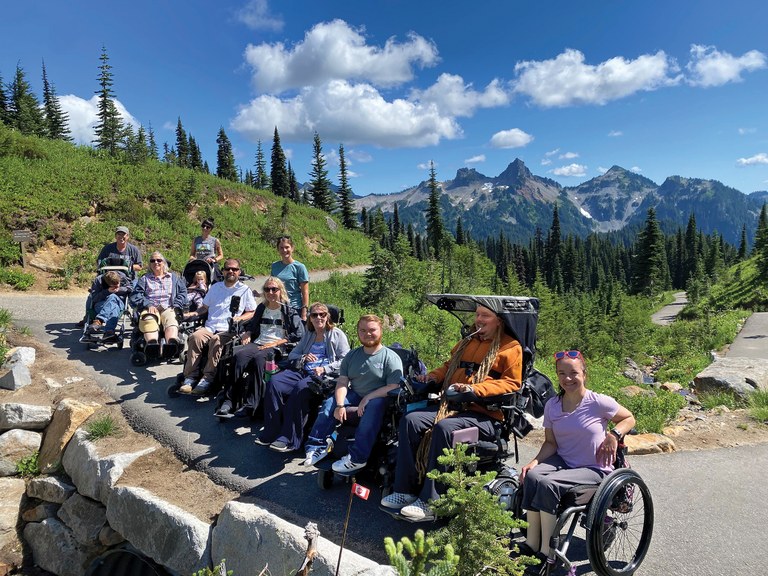 Ian Mackay has explored across Washington, including at events like Ride Tahoma. Photo by Teena Woodward
Ian emphasizes the importance of working with other people if you want to make change.
“If you work with others, you can brainstorm. You can get others to chime in with their thoughts. And by doing that, you can find connections. Maybe you can find someone in power or with influence, someone who is trying to fix what you are trying to change,” Ian said.
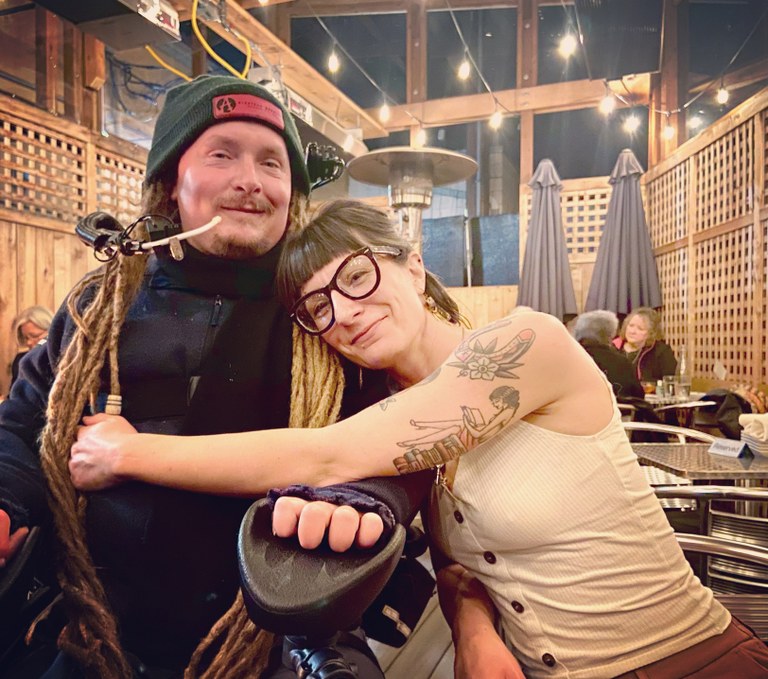
Ian and his fiancée, Celina Smith. Celina helps organize the Sea to Sound event along with Ian, his mother and others. Photo courtesy Ian Mackay
Ian has welcomed lawmakers and business leaders to join the Sea to Sound ride. Last year, the chief operating officer of wheel chair manufacturer Invacare joined them on trail. Ian had them travel 5 miles in a power wheelchair to gain a better understanding of the experience the disabled community has when recreating outside in a power wheelchair. It helped the executive understand elements of their equipment, such as suspension, speed and battery life, in a different way in a real-life, outdoor setting like a trail.
Ian knows those in-person experiences make a big difference. He appreciates that Invacare’s COO got to see how much value the outdoors can have for people who use wheelchairs — and remember that they should build wheelchairs for people, not for insurance companies. It’s important to him to connect with equipment manufacturers and help them understand the needs.
“I think once people are able to see the positive impact of what we’re doing, they’re going to want to make that change,” he said.
For more on Ian’s work, visit iansride.com.


