 Washington Trails
Association
Washington Trails
Association
Trails for everyone, forever
Washington Trails
AssociationTrails for everyone, forever
A bomb cyclone brought down massive tangles of trees. WTA helped lead the charge to clean it up. By Chloe Ferrone
In November 2024, a large storm system — referred to as a bomb cyclone — ripped through the Pacific Northwest, causing severe damage to trails and property across Washington state. Tiger Mountain was hit was particularly hard, with dozens of trees torn up by the roots and blown across miles of trails and roads on the mountain.
With its network of well-maintained paths and its proximity to Seattle and surrounding areas, the Tiger Mountain trails, managed by the Department of Natural Resources (DNR), are hugely popular with day hikers and mountain bikers. Because of that, it was clear in the wake of the storm that cleanup efforts would need to be swift and efficient. And that would require coordinating across multiple agencies and nonprofit partners to get the job done.
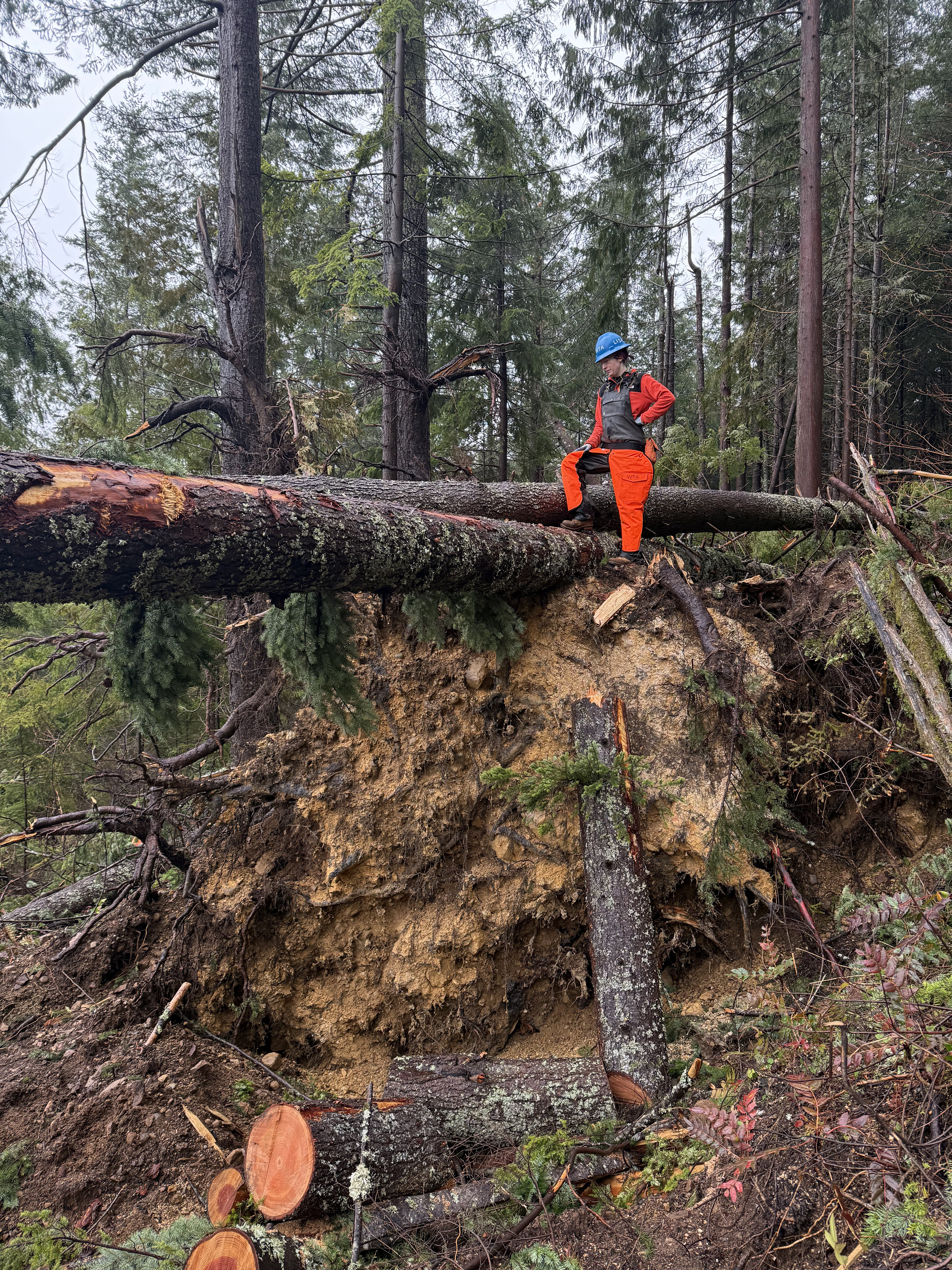
Liza Noworyta, professional crew coordinator and a B sawyer, looks at damage at Tiger Mountain.
Thanks to WTA’s skilled staff and volunteers — as well as a strong partnership with land managers like DNR — we were able to act quickly to help get these popular trails safe and hikable again.
Emily Snyder, WTA’s Central Puget Sound trails and saw program coordinator, was one of the first to view the damage with DNR maintenance staff after the storm had passed.
Emily teamed up with Jenny Hakala, a recreation maintenance specialist at DNR, to survey the damage. When heading up Tiger Mountain, the crew initially drove past a familiar road gate because of the number of downed trees blocking it from sight. All across the trail system, tangled masses of trunks, limbs, root wads and debris created a three-dimensional puzzle of trees that would need to be cleared.
“None of us had ever seen anything that was that devastating,” Emily said. “We couldn’t even find the roads, never mind the trails.”
The wind gusts had moved up drainages and draws with incredible force, leaving wide swathes of the forest leveled.
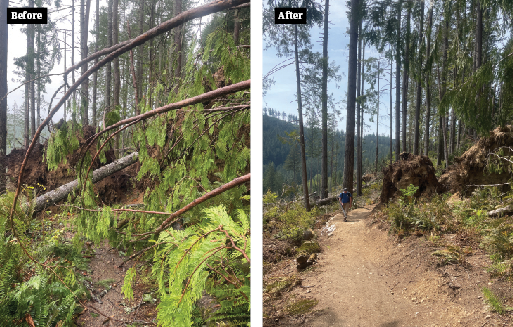
Damage from storm, before and after trail crews hard work. Photos courtesy of Jenny Hakala
Jenny determined that roughly 60 miles of DNR trails were severely damaged by the bomb cyclone storm event. “Trails were covered in uprooted trees and jackstraw piles that were impassable and seemingly impossible to tackle,” she said.
Meteorological elements had aligned to create the perfect storm, but fortunately for Tiger Mountain, circumstances also aligned to allow WTA to aid with the cleanup quickly and efficiently. Emily recognized this as a “once-in-a-lifetime” opportunity to put sawyers to work and to get some intensive saw time for those who wanted it. Unfortunately, only a few work days remained in WTA’s contract with DNR. So Emily got creative and scheduled chainsaw trainings for the area as a way to continue the work.
Emily was also being bombarded with volunteer requests to come out and help clear the damage.
“All our WTA chainsaw sawyers wanted to help,” she said. “My phone was ringing off the hook.”
The chaotic aftermath of the storm gave crew leaders and assistant crew leaders a chance to get as much saw time as they wanted.
“This was all pretty highly technical stuff and it speaks to the fact that we have really well-trained volunteers who have really high-level skill sets,” Emily said. “People are interested in learning these high-level skills, and they want to be able to use those skills to be responsive to community needs and projects. This storm cleanup was a great way to apply all the skills we teach our volunteer leadership and high-level sawyers.”
Emily explained that the saw trainings on Tiger Mountain proved to be a great opportunity to get hands-on training time for anybody looking to level up from a B-level to a C-level sawyer because everything they were cutting was so complex. “This was not something that just anybody could go in and do without an advanced level of training and experience. It was definitely highly skilled work,” she said.
Everything the crews were cutting had to be done very carefully, with supervision and collaboration. “For many WTA instructors, once they’re cutting at those advanced levels, they end up spending more time teaching newer sawyers than actually running the saw themselves, so their own skill development drops off or gets rusty,” Emily said. “We used the Tiger work as advanced sawyer trainings so our B- and C-level instructors could actually get some trigger time and get to cut with other skilled sawyers. We learned a lot doing that. Our C sawyers fine-tuned their technical skills and cutting techniques, and some of our B sawyers were able to level up to C with the experience they gained, problem-solving their way through those debris piles.”
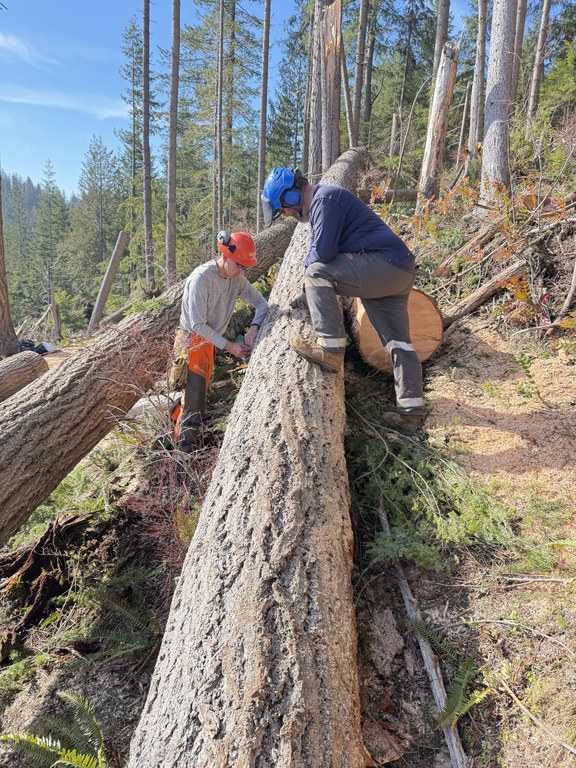
Two sawyers working together to clear trail.
The decision was made to prioritize main trails and easy loops, focusing on high-use trails. Last to open were longer connector trails, such as the south end of Tiger Mountain Trail and Side Hustle. One challenge the crews faced was the intricate network of tangled trees, unbalanced root wads and the puzzle of deciding cut order and pattern to clear the trees safely.“It could not be overstated the size and complexity of these blowdowns that required highly skilled and trained sawyers, a WTA specialty,” Jenny said.
Another unique aspect of the project was the fact that it was freshly downed, green wood. Wind-loaded down trees store a lot of energy and have the potential to move dynamically when they are cut, with cut pieces often moving many feet in opposite directions at high speed. Recognizing the hazards, knowing where to stand to make those release cuts safely and how to control the release, minimizing dynamic movement with your cut plan, is an essential skill of high-level sawyers.
“There was a lot of physics happening,” Emily explained. “When trees blow down, the fibers in their trunks and limbs are under tension and compression. Sawyers call that ‘bind.’ When you cut through the bind, your saw can stick in the compression wood, or the tension wood can break or split spontaneously, moving with force in any direction. Identifying and mitigating all the potential movement and sticking points to come up with a cut plan that provided some safe space to stand sometimes took two to three sawyers strategizing together. Steep slopes and large-diameter trees added to this complexity. If you were lucky, you got to be the one to execute it. We learned a lot through trial and error, but always with safety in mind.”
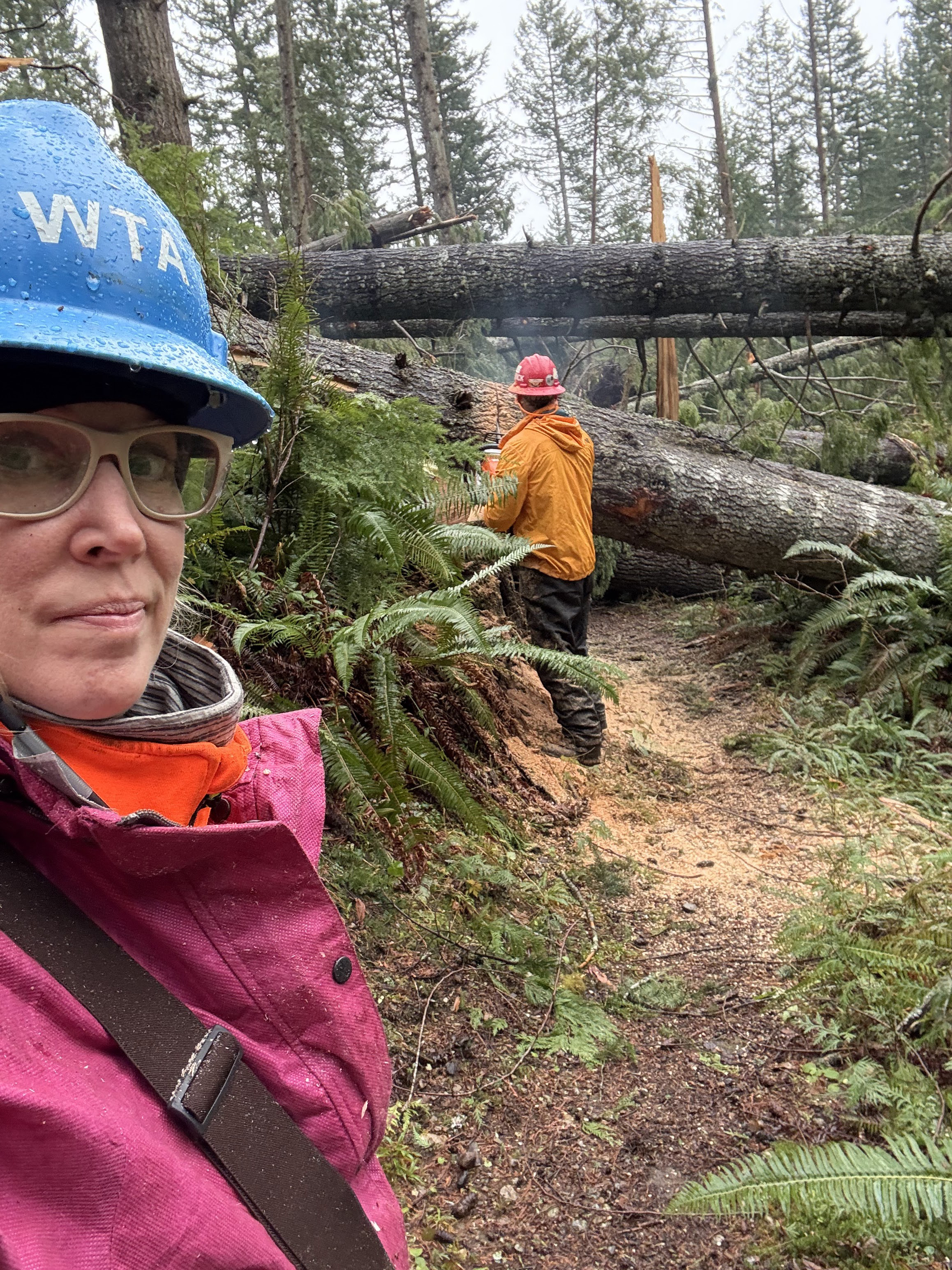
Emily Synder on the scene with trail crews.
Squak Mountain was another area where WTA worked to clean up the damage. King County crews went in and cut a basic path through the storm damage with their chainsaw crews, with WTA crews coming in behind them with crosscut saws and rigging, rebuilding the trail as they went.
“We did a lot of tread repair, some rigging and more cutting in order to get those trails back to a standard corridor width and safe to be on again,” Emily said.
Another opportunity for collaboration came when WTA renewed its contract with DNR. The storm made everyone recognize the need to include language that allowed for contingencies, especially storm cleanup and rebuilding efforts should the trails ever need it.
“When the new contract was written, the wording changed so that we could pivot more easily if needed. One of our big learnings and takeaways from the whole thing was that our contract language was pretty locked down to the projects that we had agreed on with DNR,” Emily said. The new contract now allows work days and resources to be diverted to storm cleanup if trails are hit with another big storm.
Emily emphasized that the work was made possible by the strong partnerships between WTA and DNR, as well as the amazing certified volunteer sawyers from WTA, Evergreen Mountain Bike Alliance (EMBA) and other organizations who came out and helped, such as Washington Conservation Corps and Northwest Youth Corps.
“We all learned a lot about trail work, but what resonated the most were the strong partnerships in the nonprofit community that helped us get the trails back open to the public,” Jenny said. “WTA and EMBA sawyers came to the rescue, and with Conservation Corps crews and DNR staff, at least 4,000 hours were put into clearing these trails.”
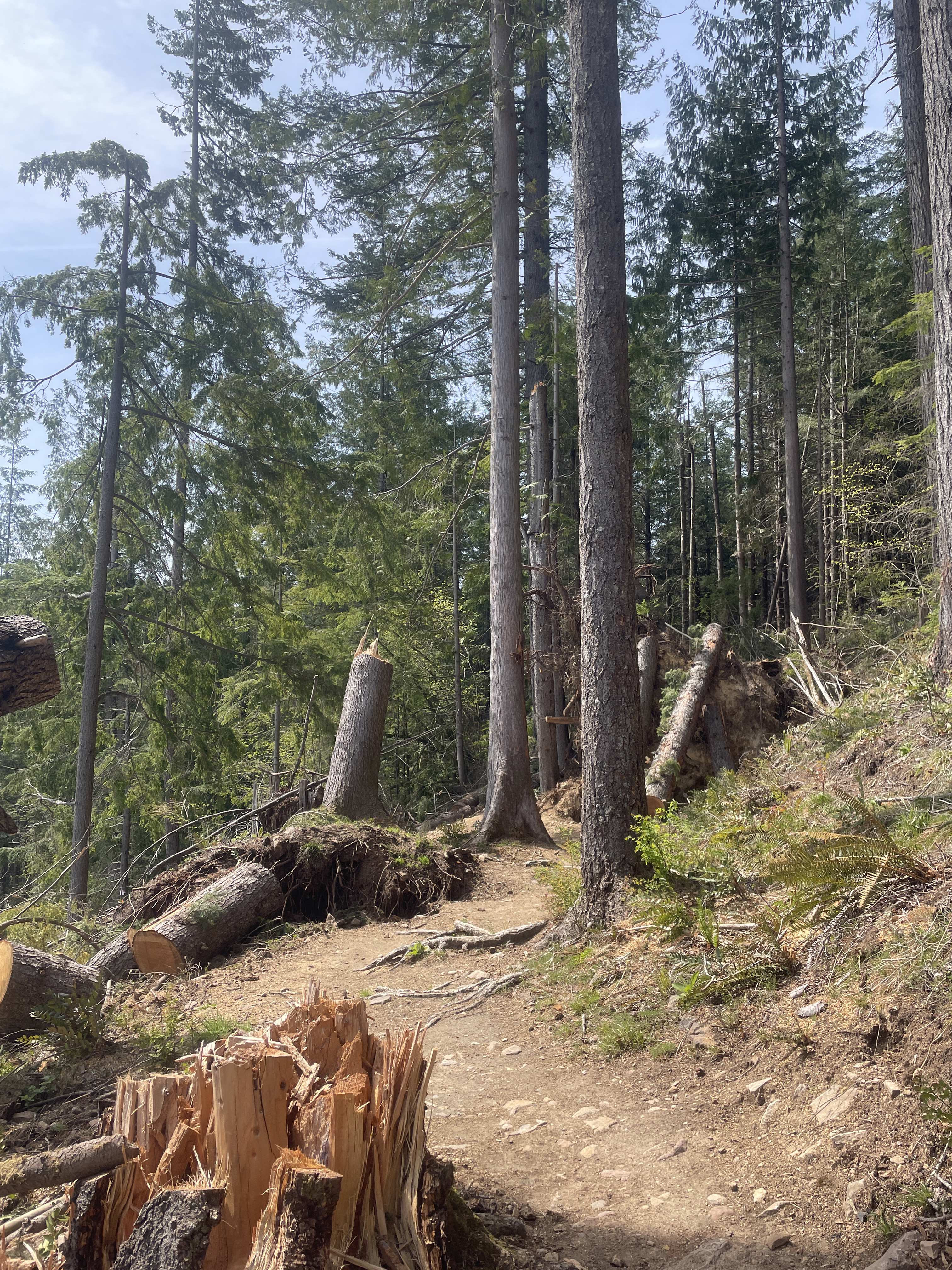
Many hours of work went into clearing these trails. Photo by Emily Synder.
Jenny added that WTA helped spread the word about the trail closures, making her and her crew’s job easier.
“People tend to push past closures thinking they can handle it, but when trails are closed, it’s for both safety and sustainability. Whether it’s closed because it’s an impassable trail or crews are currently working on these trails doing dangerous work, please respect the closures,” she said. “They are in place for your safety and the safety of the crews while they’re working.” She also emphasized that it’s important to have land manager permission before doing any work. Trail users are encouraged to report any issues with a trail and let the land manager determine the best way to address it.
Nine months later, the storm-damaged trails have all been reopened. WTA volunteer crews continue to work on the Tiger Mountain trail system. Over the last 2 years, they have helped build a reroute of the Middle Tiger Trail and a 1-mile section of the Tiger Mountain Trail impacted by the Tree Tip timber sale. Just this July, they completed a newly built trail junction and tread improvements through the logging scar to reopen the last closed section of that trail. There is still tread repair left to do, both from the bomb cyclone as well as general maintenance.


